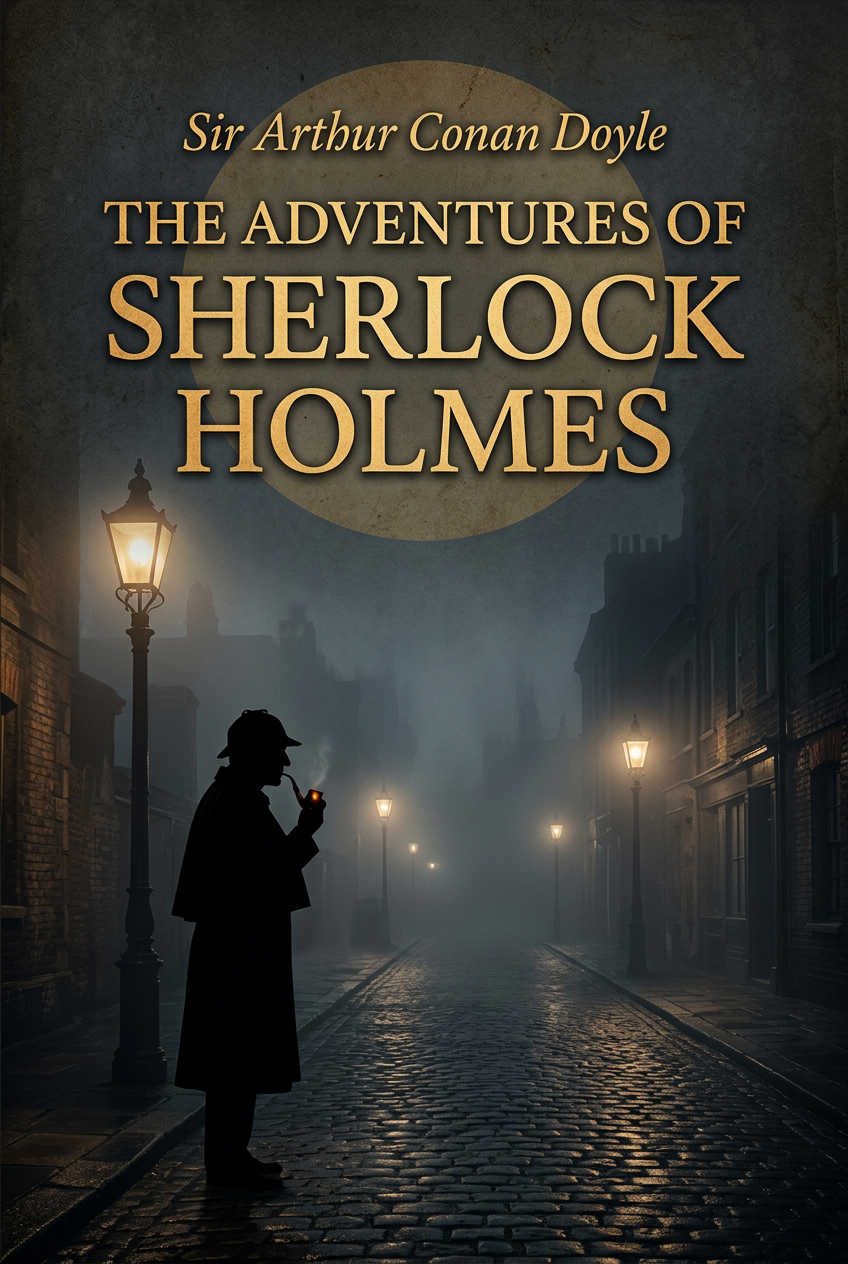
| Author | Arthur Conan Doyle |
| Genre | Fiction & Classic Novels |
| Language | English |
| Pages | 935 |
| File Size | 126 |
Book Summary
In The Adventures of Sherlock Holmes, Sir Arthur Conan Doyle invites you into the fog-shrouded streets of Victorian London and the cozy, firelit study at 221B Baker Street. Through the eyes of the loyal Dr. John Watson, we witness the brilliant, eccentric, and often inscrutable Sherlock Holmes as he applies his “science of deduction” to cases that baffle Scotland Yard.
From the high-stakes scandal of “A Scandal in Bohemia” to the bizarre puzzle of “The Red-Headed League,” these twelve stories showcase Holmes at the height of his powers. He doesn’t just solve crimes; he untangles the human heart and exposes the intricate clockwork of the criminal mind.
Additional Information
“DR. WATSON Mr. Sherlock Holmes,” said young Stamford, bless the boy, introducing this famous pair in the opening pages of A Study in Scarlet. The scene was the chemical laboratory at St. Bartholomew’s Hospital, in London.
“How are you?” cried Holmes, gripping the doctor’s hand with unexpected strength. “You have been in Afghanistan, I perceive!” Has any more momentous meeting of immortals occurred within the memory of living man?-any meeting more prophetic of inno-cent, enduring happiness for the entire reading race?
What Watson saw was a man “rather over six feet, and so ex-cessively lean that he seemed considerably taller.” His grey eyes were sharp and piercing, and these, together with a “thin, hawk-like nose,” gave his expression “an air of alertness and decision.” His chin too bore out the impression of resolution; it had “the prominence and squareness which mark a man of determination.” Such was Sherlock Holmes, aet. 27, as he appeared in the year 1881. It is a portrait familiar to countless thousands of his ad-mirers in all parts of the earth. The civilized inhabitants of our planet who are strangers to the face and fame of the world’s best documented detective are probably less numerous than the stones left unturned in the gardens of detective literature. If he is ninety-ish now, and “somewhat crippled by occasional attacks of rheu-matism,” the austere old gentleman puttering among his bees on the Sussex Downs (about five miles from Eastbourne) has not greatly changed, for it is axiomatic that a man is no older than his memories..
Memories of days and nights in Baker Street… with the rain beating against the windows and the wind sobbing like a child in the chimney… or the sound of a belated hansom rattling up from Oxford Street in the yellow fog… or hurrying feet on the seven-teen steps that led upward to the detective’s chambers… those moments of delicious anticipation, of impending revelation, just before the arrival of some client in desperate plight… the begin-ning of a new chapter of adventure. Are not these the memories of Sherlock Holmes as they are the memories of a world of wonder-ing, grateful, sentimental Watsons?
Even as in the age of Plutarch there were skeptical men who rejected the popular account of the founding of Rome, because it appeared to them to have rather the air of romance than of history, there are today, one hears with regret, scholars who doubt the existence of Sherlock Holmes and look with suspicion on the series of criminal investigations by which he is remembered. That is an unhappy state of mind; and obviously these are not the men to be passing on the merits of the Master’s deductions from the condition of the bell-rope at Abbey Grange. With Plutarch and Macaulay one can only retort upon such doubters that chance sometimes turns poet and produces trains of events not to be distinguished from the elaborate plots constructed by art.
And the house in Baker Street still stands. It will go on standing, as Mr. Irving Dilliard has remarked, as long as the cold London fog rolls in with the winter and mischief is planned and thwarted and books are written and read.
But with all that followed the memorable encounter at Bart’s the world has been long acquainted. It is the duty of an historian, introducing one of the great books of the world, to speak also of what went before.
As it happens, there had been an earlier meeting no less memor-able in its consequences, for indeed the consequences were the same. It was precisely the same meeting, in point of fact, but on another and earlier plane of experience.
The year was 1876 when Arthur Conan Doyle, a young man scantily subsisting in Edinburgh he had been born in Scotland of Irish parents entered the University there, as a student of medicine, and fell under the spell of a remarkable instructor. Joseph Bell, M.D., F.R.C.S. (Edinburgh), consulting surgeon to the Royal Infirmary and Royal Hospital for Sick Children, was a local celeb-rity. He was to quote his favorite student “thin, wiry, dark, with a high-nosed acute face, penetrating grey eyes, angular shoul-ders, and a jerky way of walking.” His voice was “high and dis-cordant.” He was a skilful surgeon, but his specialty was diagnosis and his uncanny trick of diagnosis was a legend of the institution.
“He would sit in his receiving room,” wrote Dr. Conan Doyle, later in life, “with a face like a red Indian, and diagnose the patients as they came through the door-sometimes before they had opened their mouths. He would tell them their symptoms and even give them details of their past life, and very seldom was he in error.”
In one of Bell’s best cases, recalled by Doyle, he received a civi-lian patient, and the following dialogue ensued:
“Well, my man, you’ve served in the army!”
“Aye, sir.”
“Not long discharged?”
“No, sir.”
“A Highland regiment?”
“Aye, sir.”
“A non-com. officer?”
“Aye, sir.”
“Stationed at Barbados?”
“Aye, sir.”
“You see, gentlemen,” explained the physician to his students and helpers, “the man was respectful, but he did not remove his hat. They do not in the army; but he would have learned civilian ways if he had been long discharged. As to Barbados, his complaint is elephantiasis, which is West Indian not British.”
Are not these the very accents of Sherlock Holmes? To the pro-fessor’s “audience of Watsons” it all seemed miraculous until it was explained, said Conan Doyle, and he was one of them.
He recalled this episode, and others no less remarkable, some years later, as he sat in his patients’ waiting room-three chairs, a table and a patch of carpet smoking his pipe and waiting for people to fall ill. Times had not been of the best. For a number of years the young man had been eking out the slender returns of his medical practice by writing stories for the magazines. But he was getting no forrader, and the memory of his eccentric instructor visited him with the impact of an inspiration.